Ideas that Span Generations
What innovations might be possible if we took Cathedral Thinking seriously?

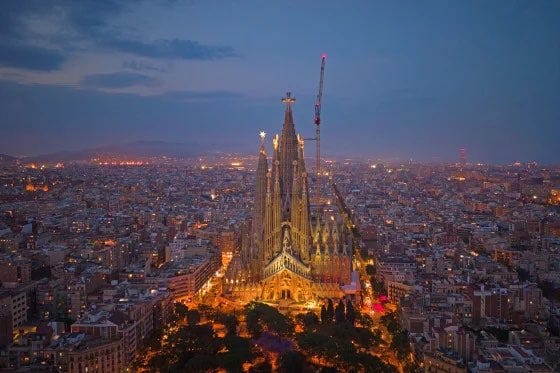
La Sagrada Família in Barcelona, Spain, at dusk. — Emilio Morenatti / AP
“Cathedral thinking takes the long view. It means pursuing an ambitious goal or idea that might require several generations to complete. It means laboring in the present in service of future glory. It’s a mentality that allowed humans to achieve some of the greatest, most spectacular projects in history.” — Jonathan Thompson
Today (June 10, 2026) is a milestone in the 140-year project that is La Sagrada Familia Basilica in Barcelona, Spain. Pope Leo will bless the main spire of the cathedral in a ceremony marking the recent completion of that tower and the 100th anniversary of the death of its architect.
Yes you heard that right. Antoni Gaudi started his work on the church in 1883 and worked on it till his death in 1926 (That is 43 years!). But that was nothing compared to the subsequent 100 years it has taken to get us close to completion today.
The Basilica’s website has a wonderful timeline and I counted the number of people that have led the project since Gaudi died. Can you guess the number? I counted at least 6, however the timeline stops listing names in recent years. That means no fewer than 8 (including the initiator - Francisco de Paula del Villar) leaders directed building this incredible piece of architecture.
La Sagrada Familia is a timely reminder of an important concept in innovation practice — Cathedral Thinking. This concept is not hard to grasp. It simply means that there is creative work that takes multiple generations. The people who start the work won’t be the ones who finish it and so the work is imagined and carried out in fundamentally different ways.
Many times the people who grab on to Cathedral Thinking focus on harsh critiques of our consumer, microwave society . . . bigger, faster, cheaper and more! While that is valid, I don’t want to focus there. Instead I want to share 5 reasons why Cathedral Thinking should be part of your innovation process:
Bigger Change Means Bigger Scope: When you tackle a big problem you immediately run into increased complexity and therefore increased effort. Cathedral Thinking acknowledges this and allows it to be ok. Many times we oversimplify big changes in order to convince people to get involved. While selling big change with small scope sounds appealing, it is simply not true. The size the the change will always determine the scope of the work.
Change is Slow and Fast: We constantly hear about how much faster the world is changing. In some ways this is true and in other ways it is a misunderstanding. There is no doubt that we are experiencing significant changes (especially in the area of technology). But what we are “feeling” is actually an illusion. As many have reminded us as we grapple with the speed of change around the advances of AI, the work to get to today’s Large Language Models started decades ago. The reality is that, just like the quickened pace at the basilica’s construction site, change speeds up as its benefits begin to be felt by many. But that doesn’t change the fact that most changes take decades or centuries to be fully imagined, developed and adopted.
Transformation Has Layers: We human beings are developmental. That means that we grow and change in a progressive way rather than like a light switch. This then requires layers of new thinking, reframing, pivots, insights and building. For any problem that is of great significance, it is going to require the growth of people as they wrestle with it, learn and change. That means that the way the problem is understood today will not be the same as it is understood by those who follow us. They will learn from our successes and mistakes and hopefully incorporate that learning into new approaches. This work of transformation requires time and space to think, learn and grow.
Generational Perspectives are Powerful: As a “cathedral-sized” innovation is tackled, each generation that gets to be part of the process will bring their own unique perspectives to the work. This multi-generational dynamic adds to the richness of the solution. Imagine an innovative solution to our global water crisis incorporating the work of a Baby Boomer, Gen-Xer, Millennial, and Gen Zer? The richness of that solution would be significant.
Weight Comes with Time: We have grown up seeing time as the enemy. We say things like “Time is not on our side.” We chide people not to “waste time.” But what if time is actually a lever for significance? Time brings a depth and quality that is simply not possible with speed. It fills things out, imagines different scenarios, and adapts to the changes going on around it. All of this bestows weight on the solution. A great example is a novel that takes 10 years instead of 1. The richness of the characters, the depth of the atmosphere, the nuance of the dialogue . . . all will add weight to the final work. And many times with weight comes influence and impact!
I’m not writing this to discourage your innovator’s bias towards action or your quick and nimble experiments. In fact, we need more of those, not less. But I’m asking you to zoom out and look at the context for all your innovation activity. It is likely that your innovations today are part of a larger cathedral project and you aren’t even aware of the big problem and solution that you are working on. Grasp the big picture before you blast off for today’s experiments! Today’s work will be richer for it.
